Abstract
Early life represents a critical window for the establishment of the gut microbiome, a complex microbial ecosystem that plays a central role in intestinal health, immune system development, physical growth, and long-term disease risk. In low- and middle-income countries such as Bangladesh, infants are exposed to a range of nutritional and environmental stressors—including undernutrition, recurrent infections, and inadequate sanitation—that can significantly disrupt normal microbiome development. These challenges make the study of early-life microbiome assembly particularly important in this context. This review synthesizes recent research on gut microbiome development in Bangladeshi infants and explores how deviations from normal patterns—such as microbiome immaturity, dysbiosis, and the overrepresentation of pathogenic organisms—are associated with adverse outcomes. These include impaired intestinal function, chronic inflammation, weakened immune responses, and growth faltering. Studies consistently show that healthy infants typically undergo a predictable succession of microbial colonization, with beneficial taxa such as Bifidobacterium infantis and other members of the Bifidobacterium longum group dominating early life, particularly in breastfed infants. These microbes are crucial for metabolizing human milk oligosaccharides and supporting immune maturation. In contrast, malnourished infants often exhibit delayed or altered microbiome maturation. Their gut microbial communities resemble those of younger infants, indicating immaturity, and are often enriched with harmful or less beneficial bacteria. Importantly, conventional nutritional interventions alone have been shown to only partially restore a healthy microbiome composition, suggesting that more targeted approaches are necessary. Recent advances highlight the potential of microbiota-directed complementary foods (MDCF) and specific probiotic supplementation in addressing these issues. These interventions are designed to promote the growth of beneficial microbes and restore microbial balance. Evidence indicates that MDCF can accelerate microbiome repair, enhance gut barrier integrity, reduce intestinal inflammation, and contribute to improved growth outcomes in undernourished children. In conclusion, targeting gut microbiome development during early infancy offers a promising strategy to improve health outcomes among Bangladeshi children. However, further research is needed to determine the optimal timing, duration, and sustainability of such interventions, as well as to better understand the underlying biological mechanisms driving these benefits.
|
Published in
|
International Journal of Gastroenterology (Volume 10, Issue 1)
|
|
DOI
|
10.11648/j.ijg.20261001.15
|
|
Page(s)
|
25-31 |
|
Creative Commons
|

This is an Open Access article, distributed under the terms of the Creative Commons Attribution 4.0 International License (http://creativecommons.org/licenses/by/4.0/), which permits unrestricted use, distribution and reproduction in any medium or format, provided the original work is properly cited.
|
|
Copyright
|
Copyright © The Author(s), 2026. Published by Science Publishing Group
|
Keywords
Infants Intestinal Health, Gut Microbiome, Gut Immunity, Malnutrition, Bifidobacterium,
Microbiota-directed Complementary Foods, Environmental Enteric Dysfunction
1. Introduction
1.1. Importance of Early‐Life Microbiome
The first months to two years of life are a formative period for gut microbiome development. Microbiota establishment influences digestion, nutrient absorption, maturation of gut barrier, and immune system education.
Disruptions during this period (from poor diet, infection, antibiotic use, etc.) are linked to long‐term consequences: undernutrition, stunting, increased susceptibility to infection, possibly even metabolic disease
| [1] | Soccol CR, VandenbergheLPdS, Spier MR, Medeiros ABP, Yamaguishi CT, Lindner JDD, et al. The potential of probiotics: a review. Food Technol Biotech. 2010; 48: 413-34. |
[1]
.
1.2. Bangladesh Context
High burden of undernutrition (wasting, stunting, moderate/severe acute malnutrition).
Environmental challenges: frequent enteric infections, poor sanitation, diarrheal disease, environmental enteric dysfunction (EED).
Breastfeeding is common, but weaning foods, complementary feeding, maternal diet, and early antibiotic exposure vary
| [2] | Lin YP, Thibodeaux CH, Peña JA, Ferry GD, Versalovic J. Probiotic Lactobacillus reuteri suppress proinflammatory cytokines via c-Jun. Inflamm Bowel Dis. 2008; 14: 1068–83. |
[2]
.
1.3. Rationale for Review
In recent years, substantial research (birth cohorts, RCTs) has investigated the gut microbiome in Bangladeshi infants, including its development, associations with health, and responses to interventions.
Understanding what is known can help guide future policy, interventions, identify gaps (mechanisms, sustainability, long‐term outcomes)
| [3] | Bashashati M, Rezaei N, Shafieyoun A, McKernan DP, Chang L, Öhman L, et al. Cytokine imbalance in irritable bowel syndrome: a systematic review and meta-analysis. NeurogastroenterolMotil. 2014; 26: 1036-48. |
[3]
.
2. Development of the Gut Microbiome in Early Infancy [4]
2.1. Microbiome Development and Composition in Healthy Bangladeshi Infants
1) Succession & Key Taxa
A study of 1,132 infants aged 0 6 months in urban Dhaka assessed absolute abundances of Bifidobacterium infantis, B. longum, B. breve. B. infantis starts low at birth, increases sharply over first two months; B. longum and B. breve remain lower relatively. Another study of 222 children during first two years observed that a distinct B. longum clade expanded with the introduction of solid foods at weaning; this clade has capacity to use both breast‐milk (human milk oligosaccharides, HMOs) and plant/solid food substrates.
2) Microbiota Maturity (“microbiota‐for‐age” metrics)
Healthy infants display a progressive increase in microbiota diversity and richness over the first two years. Models have been developed (e.g. using 16S rRNA data) to compute “relative microbiota maturity index” or microbiota‐for‐age Z score (MAZ). In healthy Bangladeshi cohorts, these measures increase with age
| [5] | Darkoh C, Comer L, Zewdie G, Harold S, Snyder N, Dupont HL. Chemotactic chemokines are important in the pathogenesis of irritable bowel syndrome. PLoS One. 2014; 9: e93144. |
[5]
.
2.2. Dysbiosis, Immaturity, and Associations with Malnutrition
1) Microbiota Immaturity & Malnutrition
Children with severe acute malnutrition (SAM) show significant immaturity of gut microbiota relative to healthy age‐matched controls; standard therapeutic foods only partially correct these deviations.
2) Altered Diversity, Taxonomic Shifts
Malnourished children tend to have reduced richness and diversity, fewer beneficial taxa (e.g.
Bifidobacterium,
Prevotella), and overrepresentation of potentially pathogenic or pro‐inflammatory taxa
| [6] | Rhoads JM, Fatheree NY, Norori J, Liu Y, Lucke JF, Tyson JE, et al. Altered fecal microflora and increased fecal calprotectin in infants with colic. J Pediatr. 2009; 155: 823-8. e821. |
[6]
.
2.3. Impacts on Intestinal Health, Growth, and Immune Function | [7] | Savino F, Garro M, Montanari P, Galliano I, Bergallo M. Crying time and RORγ/FOXP3 expression in Lactobacillus reuteri DSM17938-treated infants with colic: a randomized trial. J Pediatr. 2018; 192: 171-7. e171. |
[7]
1) Growth Outcomes
Interventions that modify the microbiome, such as MDCF‐2, produce not only weight gain but also improved linear growth (length‐for‐age) in Bangladeshi children with moderate acute malnutrition over follow‐up.
2) Gut Barrier & Biomarkers
In trials, microbiota‐directed complementary foods improved biomarkers of gut health / environmental enteric dysfunction (EED), such as citrulline, reduced markers of gut inflammation.
In the study of B. infantis supplementation in infants with SAM, increased B. infantis was associated with reduced intestinal inflammation markers.
3) Cognitive / Language / Neurodevelopment
Some studies indicate that small intestine bacterial overgrowth (SIBO) is associated with poorer linear growth and also lower scores on language development (Bayley scales) in Bangladeshi children.
4) Influence of Feeding, Antibiotics, Delivery Mode
| [8] | Kim CH. FOXP3 and its role in the immune system. Adv Exp Med Biol. 2009; 665: 17-29. |
[8]
Feeding patterns (breastfeeding & timing of introduction of solid foods) importantly influence colonization by Bifidobacterium species. Cesarean vs vaginal birth shows some early differences but these tend to equalize over time. Antibiotic exposure negatively impacts microbiome richness and certain taxonomic abundance.
2.4. Interventions Aimed at Modulating the Microbiome | [9] | Kianifar H, Ahanchian H, Grover Z, Jafari S, Noorbakhsh Z, Khakshour A, et al. Synbiotic in the management of infantile colic: a randomised controlled trial. J Paediatr Child Health. 2014; 50: 801-5. |
[9]
1) Microbiota‐Directed Complementary Foods (MDCF-2)
A randomized controlled trial in children aged 12-18 months with moderate acute malnutrition showed that MDCF-2 (a food designed to activate beneficial gut bacteria) vs standard RUSF improved weight gain, and over 2-year follow up, children receiving MDCF-2 were less stunted. Also changes in metagenome-assembled bacterial genomes (MAGs) associated with growth, as well as in plasma biomarkers consistent with reduced inflammation and enhanced musculoskeletal / neurodevelopmental processes.
2) Probiotics / Bifidobacterium infantis
In infants with SAM, supplementation with B. infantis strain EVC001 (with or without HMO such as lacto-N-neotetraose) increased B. infantis abundance, improved weight gain, and reduced intestinal inflammation markers. However, even after intervention, abundances often remained below those seen in healthy, age-matched infants without malnutrition.
3) Iron Supplementation Effects on Microbiome
| [10] | Mi GL, Zhao L, Qiao DD, Kang WQ, Tang MQ, Xu JK. Effectiveness of Lactobacillus reuteri in infantile colic and colicky induced maternal depression: a prospective single blind randomized trial. Antonie Van Leeuwenhoek. 2015; 107: 1547-53. |
[10]
The BRISC trial in Bangladesh evaluated iron supplementation and its effects on microbiome. Findings: improved hematological indices, but effects on microbiome composition were relatively modest; some taxa changed depending on baseline iron status.
3. Microbiome Development: Critical Phases and Influencing Factors
3.1. Microbiome Maturation: Key Milestones & Drivers
1) The early colonization by Bifidobacterium (particularly B. infantis) appears central to healthy microbiome trajectories. These taxa metabolize HMOs in breastmilk, produce short chain fatty acids (SCFAs), lower gut pH, which can suppress pathogens.
2) Weaning / introduction of complementary feeding shifts the substrate supply in the gut, favoring expansion of taxa able to degrade plant polysaccharides, etc. The transition phase is critical — improper weaning or low diversity diets may impair microbiome maturation
| [11] | Savino F, Galliano I, Savino A, Daprà V, Montanari P, Calvi C, et al. Lactobacillus reuteri DSM 17938 probiotics may increase CC-chemokine receptor 7 expression in infants treated with for colic. Front Pediatr. 2019; 7: 1-7. |
[11]
.
3.2. Malnutrition & Immaturity: Cause, Consequence, or Both
1) Evidence suggests that immaturity of the microbiome is not merely a result of undernutrition but contributes to its pathogenesis. For example, studies in gnotobiotic mice colonized with microbiota from malnourished vs healthy Bangladeshi children have shown that microbiota from healthy donors support greater growth.
2) Standard nutritional therapy alone often fails to fully restore microbiota maturity or diversity. Interventions that specifically target microbiome (via prebiotics, HMOs, probiotics, microbiota‐directed foods) show greater promise
| [12] | Gerasimov S, Gantzel J, Dementieva N, Schevchenko O, Tsitsura O, Guta N, et al. Role of Lactobacillus rhamnosus (FloraActive™) 19070-2 and Lactobacillus reuteri (FloraActive™) 12246 in infant colic: a randomized dietary study. Nutrients. 2018; 10: 1975. |
[12]
.
3.3. Mechanisms: How the Microbiome Impacts Intestinal Health and Immunity
1) Gut barrier integrity: beneficial microbes help maintain mucosal barrier, produce SCFAs (like butyrate) that feed enterocytes, stimulate tight junction proteins.
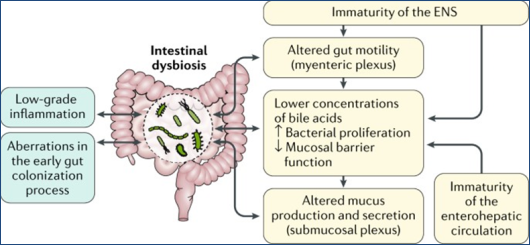
2) Regulation of gut inflammation: mature microbiome suppresses inflammatory pathways; dysbiosis can increase translocation of microbial products, chronic low-level inflammation, associated with environmental enteric dysfunction (EED).
3) Immune system education: the microbiome influences development of innate immunity (pattern recognition receptors), development of regulatory T cells, influences responses to vaccines
| [14] | Cani PD. Gut microbiota: changes in gut microbes and host metabo?lism: squaring the circle? Nat Rev Gastroenterol Hepatol 2016; 13: 563- 564. |
| [15] | Haare Zedek Medical Center, Jerusalem, Israel, The Hebrew University of Jerusalem, Jerusalem: Transl Pediatr 2019; 8(1): 42-55. |
| [16] | Jessica Carrière, Arlette Darfeuille-Michaud, Hang Thi Thu Nguyen: Infectious etiopathogenesis of Crohn’s disease: World J Gastroenterol 2014 September 14; 20(34): 12102-12117. |
[14-16]
.
3.4. Challenges: Gaps, Limitations, and Critical Questions
1) Temporal dynamics: when is optimal window for intervention? Prenatal? Early postnatal? At weaning?
2) Sustainability: many interventions show benefits while administered, but long term durability (years later) less well characterized.
3) Variability: individual differences (mode of birth, maternal microbiome, feeding practices, antibiotic exposure, environment) influence microbiome. Also geographic / seasonal variation
| [17] | Ruth K. Dudek-Wicher, Adam Junka, Marzenna Bartoszewicz: The influence of antibiotics and dietary components on gut microbiota: Gastroenterology Rev 2018; 13 (2): 85–92. |
[17]
.
4) Mechanistic proof: many studies are associative; need more mechanistic studies (animal / gnotobiotic models, omics).
5) Safety issues: risk of introducing probiotics or prebiotics in contexts of immunocompromise or infection; iron supplementation may shift taxa toward pathogenic bacteria if gut barrier weak; antibiotic resistance
| [18] | Ardeshir Rineh, Michael J Kelso2, Fatma Vatansever, George P Tegos, and Michael R Hamblin: Clostridium difficile infection: molecular pathogenesis and novel therapeutics: Expert Rev Anti Infect Ther. 2014 January; 12(1): 131–150. |
[18]
.
3.5. Implications for Policy & Practice | [19] | Sunil Sazawal 1, Girish Hiremath, Usha Dhingra, Pooja Malik, Saikat Deb, Robert E Black: Efficacy of probiotics in prevention of acute diarrhoea: a meta-analysis of masked, randomised, placebo-controlled trials: Lancet Infect Disease, 2006 Jun; 6(6): 374-82. |
[19]
1) Design of complementary foods should consider microbiota‐activating ingredients (e.g. HMOs, plant polysaccharides).
2) Breastfeeding promotion remains critical. Ensuring maternal nutrition so HMOs in breast milk are optimal.
3) Sanitation, hygiene, and infection control also essential to reduce perturbations.
4) Monitoring tools: metrics of microbiota maturity could be used as markers in trials / programs.
3.6. Advances in Multi-Omics Approaches for Understanding Infant Gut Microbiome Function | [20] | Supriya Roy, Suneela Dhaneshwar: Role of prebiotics, probiotics, and synbiotics in management of inflammatory bowel disease: Current perspectives: World J Gastroenterol 2023 April 14; 29(14): 2078-2100. |
[20]
Recent advances in multi-omics technologies—including metagenomics, metabolomics, and transcriptomics—have significantly improved the understanding of early-life gut microbiome dynamics in infants. These approaches allow researchers to move beyond simple taxonomic descriptions toward functional characterization of microbial communities. For example, metabolomic profiling has demonstrated that beneficial gut microbes produce metabolites such as short-chain fatty acids (SCFAs), which regulate epithelial integrity, enhance mucin production, and modulate immune signaling pathways. In Bangladeshi infant cohorts, alterations in microbial metabolic activity have been associated with markers of intestinal inflammation and impaired nutrient utilization. Integrating multi-omics data with clinical and nutritional information may therefore provide a more comprehensive understanding of host–microbiome interactions and identify novel biomarkers for early detection of microbiome-associated growth and immune disorders.
3.7. The Maternal–Infant Microbiome Axis and Its Role in Early Gut Colonization | [21] | Wasilewski A, Zielińska M, Storr M, Fichna J. Beneficial Effects of Probiotics, Prebiotics, Synbiotics, and Psychobiotics in Inflammatory Bowel Disease. Inflamm Bowel Dis. 2015 Jul; 21(7): 1674-82.
https://doi.org/10.1097/MIB.0000000000000364 |
[21]
Another important consideration for improving infant gut health in Bangladesh is the maternal–infant microbiome axis. Maternal nutritional status, gut microbiota composition, and health conditions during pregnancy can influence the initial microbial inoculum transmitted to the infant during birth and breastfeeding. Breast milk not only provides essential nutrients but also contains bioactive components such as human milk oligosaccharides (HMOs), immune factors, and beneficial bacteria that shape infant microbiota composition. Maternal malnutrition, infections, or antibiotic exposure may alter these microbial and immunological components, potentially affecting infant microbiome maturation. Therefore, future intervention strategies should not focus solely on infants but also include maternal nutrition, antenatal care, and breastfeeding support programs to optimize the microbial and immunological foundation established during early life.
3.8. Future Research Directions and Implementation Challenges | [22] | Lee YS, Yu HY, Kwon M, Lee SH, Park JI, Seo J, Kim SK. Probiotic Characteristics and Safety Assessment of Lacticaseibacillus casei KGC1201 Isolated from Panax ginseng. J Microbiol Biotechnol. 2023 Apr 28; 33(4): 519-526.
https://doi.org/10.4014/jmb.2211.11029 |
[22]
Despite increasing evidence supporting the role of the gut microbiome in infant growth and immune development, several research and implementation challenges remain. Many current studies in Bangladesh rely on observational cohort data, which limits the ability to establish clear causal relationships between microbiome alterations and health outcomes. Larger longitudinal studies and well-designed randomized controlled trials are needed to determine the most effective microbiome-targeted interventions, including optimal timing, dosage, and duration. Additionally, translating research findings into scalable public health strategies requires consideration of affordability, cultural dietary practices, and accessibility in low-resource settings. Strengthening collaborations between microbiologists, nutritionists, clinicians, and public health policymakers will be essential for developing sustainable microbiome-based interventions that can effectively improve child health outcomes in Bangladesh.
4. Conclusions
The gut microbiome in Bangladeshi infants follows characteristic trajectories: early predominance by Bifidobacterium, increasing diversity with age/weaning; deviation from this trajectory (immaturity, low diversity, overgrowth of inflammatory or pathogenic taxa) associates with malnutrition, growth faltering, poor gut barrier function, and compromised immunity. Interventions targeted at the microbiome (e.g., microbiota‐directed complementary foods, B. infantis supplementation) have shown promising results in improving weight, linear growth, reducing gut inflammation, and ameliorating biomarkers of intestinal health. However, full repair of microbiome maturity is rarely achieved with standard treatments alone. Future work should aim to define optimal timing and composition of interventions, understand long‐term outcomes (including immune function, vaccination response, cognitive development), and to develop scalable, culturally acceptable microbiome‐modulating strategies in low‐resource settings. Overall, modulating early life gut microbiome offers a potent avenue for improving intestinal health and immune resilience among Bangladeshi infants, with potential for high impact in reducing the burden of undernutrition, infection, and growth stunting.
Author Contributions
Anm Saiful Hasan: Conceptualization, Data curation, Formal Analysis, Investigation, Methodology, Project administration, Supervision, Validation, Visualization, Writing – original draft, Writing – review & editing
Firoz Ahmed: Conceptualization, Data curation, Formal Analysis, Investigation, Methodology, Project administration, Supervision, Validation, Visualization
Ehsanul Haque Masum: Conceptualization, Data curation, Formal Analysis, Investigation, Methodology, Project administration, Supervision, Validation, Visualization, Writing – original draft
Minhaz Ahmed Mithu: Conceptualization, Data curation, Formal Analysis, Investigation, Methodology, Project administration, Supervision, Validation, Visualization, Writing – original draft, Writing – review & editing
Partha Pratim Shikder: Conceptualization, Data curation, Formal Analysis, Investigation, Methodology, Project administration
Conflicts of Interest
No conflict of interest declared by authors.
References
| [1] |
Soccol CR, VandenbergheLPdS, Spier MR, Medeiros ABP, Yamaguishi CT, Lindner JDD, et al. The potential of probiotics: a review. Food Technol Biotech. 2010; 48: 413-34.
|
| [2] |
Lin YP, Thibodeaux CH, Peña JA, Ferry GD, Versalovic J. Probiotic Lactobacillus reuteri suppress proinflammatory cytokines via c-Jun. Inflamm Bowel Dis. 2008; 14: 1068–83.
|
| [3] |
Bashashati M, Rezaei N, Shafieyoun A, McKernan DP, Chang L, Öhman L, et al. Cytokine imbalance in irritable bowel syndrome: a systematic review and meta-analysis. NeurogastroenterolMotil. 2014; 26: 1036-48.
|
| [4] |
Pike BL, Paden KA, Alcala AN, Jaep KM, Gormley RP, Maue AC, et al. Immunological biomarkers in postinfectious irritable bowel syndrome. J Travel Med. 2015; 22: 242-50.
|
| [5] |
Darkoh C, Comer L, Zewdie G, Harold S, Snyder N, Dupont HL. Chemotactic chemokines are important in the pathogenesis of irritable bowel syndrome. PLoS One. 2014; 9: e93144.
|
| [6] |
Rhoads JM, Fatheree NY, Norori J, Liu Y, Lucke JF, Tyson JE, et al. Altered fecal microflora and increased fecal calprotectin in infants with colic. J Pediatr. 2009; 155: 823-8. e821.
|
| [7] |
Savino F, Garro M, Montanari P, Galliano I, Bergallo M. Crying time and RORγ/FOXP3 expression in Lactobacillus reuteri DSM17938-treated infants with colic: a randomized trial. J Pediatr. 2018; 192: 171-7. e171.
|
| [8] |
Kim CH. FOXP3 and its role in the immune system. Adv Exp Med Biol. 2009; 665: 17-29.
|
| [9] |
Kianifar H, Ahanchian H, Grover Z, Jafari S, Noorbakhsh Z, Khakshour A, et al. Synbiotic in the management of infantile colic: a randomised controlled trial. J Paediatr Child Health. 2014; 50: 801-5.
|
| [10] |
Mi GL, Zhao L, Qiao DD, Kang WQ, Tang MQ, Xu JK. Effectiveness of Lactobacillus reuteri in infantile colic and colicky induced maternal depression: a prospective single blind randomized trial. Antonie Van Leeuwenhoek. 2015; 107: 1547-53.
|
| [11] |
Savino F, Galliano I, Savino A, Daprà V, Montanari P, Calvi C, et al. Lactobacillus reuteri DSM 17938 probiotics may increase CC-chemokine receptor 7 expression in infants treated with for colic. Front Pediatr. 2019; 7: 1-7.
|
| [12] |
Gerasimov S, Gantzel J, Dementieva N, Schevchenko O, Tsitsura O, Guta N, et al. Role of Lactobacillus rhamnosus (FloraActive™) 19070-2 and Lactobacillus reuteri (FloraActive™) 12246 in infant colic: a randomized dietary study. Nutrients. 2018; 10: 1975.
|
| [13] |
Christopher McDowell; Umer Farooq; Muhammad Haseeb: Inflammatory Bowel Disease: August 4, 2023.
|
| [14] |
Cani PD. Gut microbiota: changes in gut microbes and host metabo?lism: squaring the circle? Nat Rev Gastroenterol Hepatol 2016; 13: 563- 564.
|
| [15] |
Haare Zedek Medical Center, Jerusalem, Israel, The Hebrew University of Jerusalem, Jerusalem: Transl Pediatr 2019; 8(1): 42-55.
|
| [16] |
Jessica Carrière, Arlette Darfeuille-Michaud, Hang Thi Thu Nguyen: Infectious etiopathogenesis of Crohn’s disease: World J Gastroenterol 2014 September 14; 20(34): 12102-12117.
|
| [17] |
Ruth K. Dudek-Wicher, Adam Junka, Marzenna Bartoszewicz: The influence of antibiotics and dietary components on gut microbiota: Gastroenterology Rev 2018; 13 (2): 85–92.
|
| [18] |
Ardeshir Rineh, Michael J Kelso2, Fatma Vatansever, George P Tegos, and Michael R Hamblin: Clostridium difficile infection: molecular pathogenesis and novel therapeutics: Expert Rev Anti Infect Ther. 2014 January; 12(1): 131–150.
|
| [19] |
Sunil Sazawal 1, Girish Hiremath, Usha Dhingra, Pooja Malik, Saikat Deb, Robert E Black: Efficacy of probiotics in prevention of acute diarrhoea: a meta-analysis of masked, randomised, placebo-controlled trials: Lancet Infect Disease, 2006 Jun; 6(6): 374-82.
|
| [20] |
Supriya Roy, Suneela Dhaneshwar: Role of prebiotics, probiotics, and synbiotics in management of inflammatory bowel disease: Current perspectives: World J Gastroenterol 2023 April 14; 29(14): 2078-2100.
|
| [21] |
Wasilewski A, Zielińska M, Storr M, Fichna J. Beneficial Effects of Probiotics, Prebiotics, Synbiotics, and Psychobiotics in Inflammatory Bowel Disease. Inflamm Bowel Dis. 2015 Jul; 21(7): 1674-82.
https://doi.org/10.1097/MIB.0000000000000364
|
| [22] |
Lee YS, Yu HY, Kwon M, Lee SH, Park JI, Seo J, Kim SK. Probiotic Characteristics and Safety Assessment of Lacticaseibacillus casei KGC1201 Isolated from Panax ginseng. J Microbiol Biotechnol. 2023 Apr 28; 33(4): 519-526.
https://doi.org/10.4014/jmb.2211.11029
|
Cite This Article
-
APA Style
Hasan, A. S., Ahmed, F., Akhter, M. S., Masum, E. H., Mithu, M. A., et al. (2026). The Beneficial Role of Early-Life Gut Microbiota Development for Improving Intestinal Health Integrity and Gut-Immune Function in Infants of Bangladesh. International Journal of Gastroenterology, 10(1), 25-31. https://doi.org/10.11648/j.ijg.20261001.15
 Copy
|
Copy
|
 Download
ACS Style
Hasan, A. S.; Ahmed, F.; Akhter, M. S.; Masum, E. H.; Mithu, M. A., et al. The Beneficial Role of Early-Life Gut Microbiota Development for Improving Intestinal Health Integrity and Gut-Immune Function in Infants of Bangladesh. Int. J. Gastroenterol. 2026, 10(1), 25-31. doi: 10.11648/j.ijg.20261001.15
Copy
|
Download
AMA Style
Hasan AS, Ahmed F, Akhter MS, Masum EH, Mithu MA, et al. The Beneficial Role of Early-Life Gut Microbiota Development for Improving Intestinal Health Integrity and Gut-Immune Function in Infants of Bangladesh. Int J Gastroenterol. 2026;10(1):25-31. doi: 10.11648/j.ijg.20261001.15
Copy
|
Download
-
@article{10.11648/j.ijg.20261001.15,
  author = {Anm Saiful Hasan and Firoz Ahmed and Mst Sajia Akhter and Ehsanul Haque Masum and Minhaz Ahmed Mithu and Partha Pratim Shikder},
  title = {The Beneficial Role of Early-Life Gut Microbiota Development for Improving Intestinal Health Integrity and Gut-Immune Function in Infants of Bangladesh},
  journal = {International Journal of Gastroenterology},
  volume = {10},
  number = {1},
  pages = {25-31},
  doi = {10.11648/j.ijg.20261001.15},
  url = {https://doi.org/10.11648/j.ijg.20261001.15},
  eprint = {https://article.sciencepublishinggroup.com/pdf/10.11648.j.ijg.20261001.15},
  abstract = {Early life represents a critical window for the establishment of the gut microbiome, a complex microbial ecosystem that plays a central role in intestinal health, immune system development, physical growth, and long-term disease risk. In low- and middle-income countries such as Bangladesh, infants are exposed to a range of nutritional and environmental stressors—including undernutrition, recurrent infections, and inadequate sanitation—that can significantly disrupt normal microbiome development. These challenges make the study of early-life microbiome assembly particularly important in this context. This review synthesizes recent research on gut microbiome development in Bangladeshi infants and explores how deviations from normal patterns—such as microbiome immaturity, dysbiosis, and the overrepresentation of pathogenic organisms—are associated with adverse outcomes. These include impaired intestinal function, chronic inflammation, weakened immune responses, and growth faltering. Studies consistently show that healthy infants typically undergo a predictable succession of microbial colonization, with beneficial taxa such as Bifidobacterium infantis and other members of the Bifidobacterium longum group dominating early life, particularly in breastfed infants. These microbes are crucial for metabolizing human milk oligosaccharides and supporting immune maturation. In contrast, malnourished infants often exhibit delayed or altered microbiome maturation. Their gut microbial communities resemble those of younger infants, indicating immaturity, and are often enriched with harmful or less beneficial bacteria. Importantly, conventional nutritional interventions alone have been shown to only partially restore a healthy microbiome composition, suggesting that more targeted approaches are necessary. Recent advances highlight the potential of microbiota-directed complementary foods (MDCF) and specific probiotic supplementation in addressing these issues. These interventions are designed to promote the growth of beneficial microbes and restore microbial balance. Evidence indicates that MDCF can accelerate microbiome repair, enhance gut barrier integrity, reduce intestinal inflammation, and contribute to improved growth outcomes in undernourished children. In conclusion, targeting gut microbiome development during early infancy offers a promising strategy to improve health outcomes among Bangladeshi children. However, further research is needed to determine the optimal timing, duration, and sustainability of such interventions, as well as to better understand the underlying biological mechanisms driving these benefits.},
 year = {2026}
}
Copy
|
Download
-
TY  - JOUR
T1  - The Beneficial Role of Early-Life Gut Microbiota Development for Improving Intestinal Health Integrity and Gut-Immune Function in Infants of Bangladesh
AU  - Anm Saiful Hasan
AU  - Firoz Ahmed
AU  - Mst Sajia Akhter
AU  - Ehsanul Haque Masum
AU  - Minhaz Ahmed Mithu
AU  - Partha Pratim Shikder
Y1  - 2026/04/24
PY  - 2026
N1  - https://doi.org/10.11648/j.ijg.20261001.15
DO  - 10.11648/j.ijg.20261001.15
T2  - International Journal of Gastroenterology
JF  - International Journal of Gastroenterology
JO  - International Journal of Gastroenterology
SP  - 25
EP  - 31
PB  - Science Publishing Group
SN  - 2640-169X
UR  - https://doi.org/10.11648/j.ijg.20261001.15
AB  - Early life represents a critical window for the establishment of the gut microbiome, a complex microbial ecosystem that plays a central role in intestinal health, immune system development, physical growth, and long-term disease risk. In low- and middle-income countries such as Bangladesh, infants are exposed to a range of nutritional and environmental stressors—including undernutrition, recurrent infections, and inadequate sanitation—that can significantly disrupt normal microbiome development. These challenges make the study of early-life microbiome assembly particularly important in this context. This review synthesizes recent research on gut microbiome development in Bangladeshi infants and explores how deviations from normal patterns—such as microbiome immaturity, dysbiosis, and the overrepresentation of pathogenic organisms—are associated with adverse outcomes. These include impaired intestinal function, chronic inflammation, weakened immune responses, and growth faltering. Studies consistently show that healthy infants typically undergo a predictable succession of microbial colonization, with beneficial taxa such as Bifidobacterium infantis and other members of the Bifidobacterium longum group dominating early life, particularly in breastfed infants. These microbes are crucial for metabolizing human milk oligosaccharides and supporting immune maturation. In contrast, malnourished infants often exhibit delayed or altered microbiome maturation. Their gut microbial communities resemble those of younger infants, indicating immaturity, and are often enriched with harmful or less beneficial bacteria. Importantly, conventional nutritional interventions alone have been shown to only partially restore a healthy microbiome composition, suggesting that more targeted approaches are necessary. Recent advances highlight the potential of microbiota-directed complementary foods (MDCF) and specific probiotic supplementation in addressing these issues. These interventions are designed to promote the growth of beneficial microbes and restore microbial balance. Evidence indicates that MDCF can accelerate microbiome repair, enhance gut barrier integrity, reduce intestinal inflammation, and contribute to improved growth outcomes in undernourished children. In conclusion, targeting gut microbiome development during early infancy offers a promising strategy to improve health outcomes among Bangladeshi children. However, further research is needed to determine the optimal timing, duration, and sustainability of such interventions, as well as to better understand the underlying biological mechanisms driving these benefits.
VL  - 10
IS  - 1
ER  -
Copy
|
Download

 ,
Firoz Ahmed
,
Firoz Ahmed


 Share This Article
 Twitter
 Linked In
 Facebook